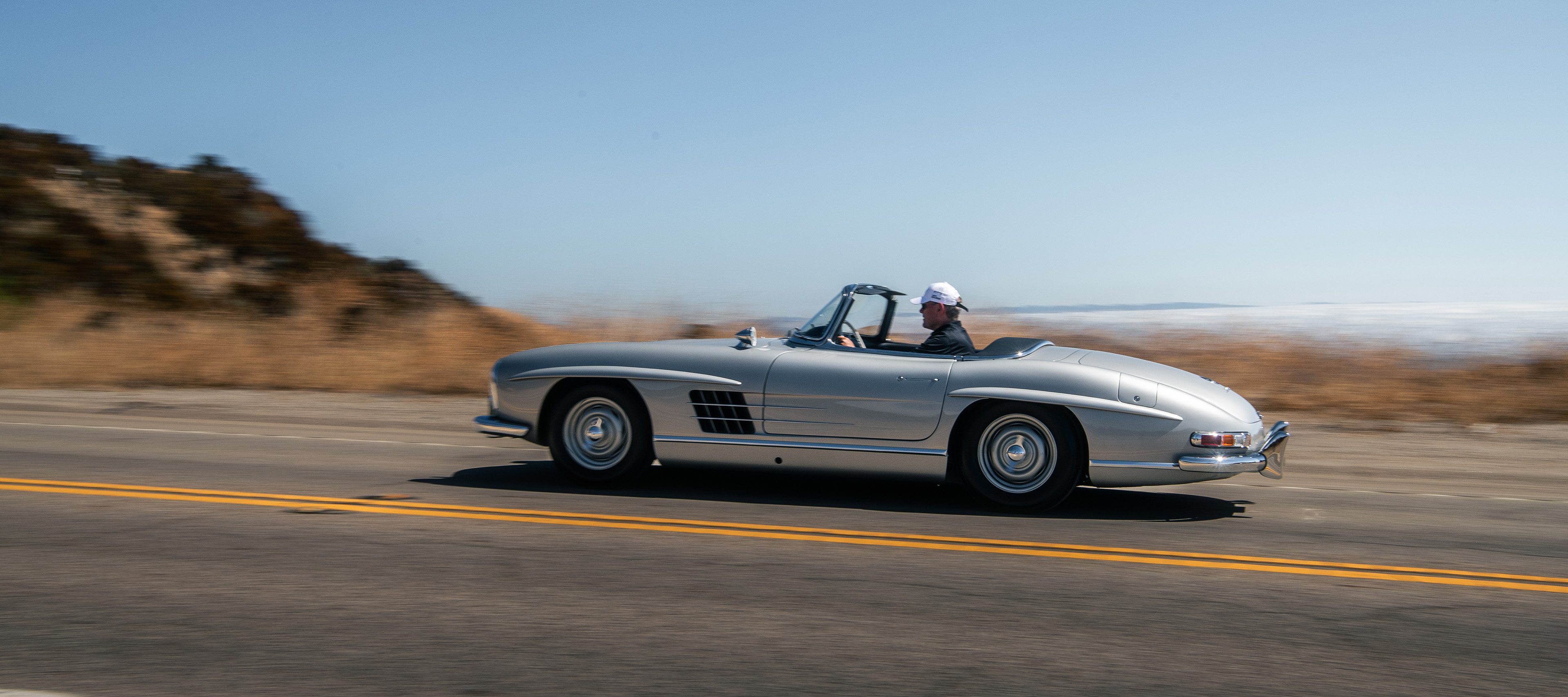
There are few simpler pleasures in life than driving a convertible on an open road with the top down. Wind in your hair, the hum of the engine, the smells and sights of the passing scenery… it’s a truly unparalleled experience.


While the earliest automobiles were all ‘topless’ (in that they were essentially mechanised horse-drawn carriages), the invention of the internal combustion engine increased the speed and power of the automobile, creating the need for an enclosed cabin. 


Of course, that didn’t end the desire for open-air driving. In the 1930s, carmakers created the retractable, self-storing roof, and later the power-operated convertible top – which meant a car’s roof could be easily raised and lowered, breathing new life into the convertible style.


The SL revolution


Open-topped vehicles have long been a staple of the Mercedes-Benz line-up, but it was in the 1950s that some of our most iconic convertibles were created.


This included the Mercedes-Benz 190 SL in 1954 as well as the 300 SL Roadster in 1957 – a lightweight, aerodynamic sports convertible that succeeded the legendary 300 SL ‘Gullwing’ Coupé. But the roadster was more than just an open version of its predecessor. It also came with improved rear-axle suspension and delivered far better performance.


The iconic roadster was unveiled at the Geneva Motor Show in March 1957, and a year later, a beautifully designed removable hardtop was available as special equipment. To this day, both versions of the 300 SL are among the most sought-after classic cars for collectors.

The 190 SL Roadster was also introduced in the 50s and quickly established itself as one of the most popular Mercedes-Benz vehicles. The elegant and sporty two-seater could be ordered as a roadster with a hood (but without a hardtop) or as a coupé with a removable hardtop. It was incredibly successful in its time: between May 1955 and February 1963, as many as 25,881 cars were built.


Capitalising on the surge in popularity of the new convertible form, Mercedes-Benz combined the best qualities of the 300 SL and the 190 SL into one stunning model: the 230 SL ‘Pagoda’, which was unveiled at the International Motor Show in Geneva in 1963. The nickname ‘Pagoda’ came from the shape of the hardtop roof, designed by legendary body designer Paul Bracq, because it was reminiscent of the roofs of traditional Asian pagodas. Its safety-conscious body and performance engine revolutionised the convertible for a new generation of drivers.


Rise of the R107


The Pagoda’s successor was introduced in 1971 – the Mercedes-Benz R 107. This luxurious convertible quickly became an icon of 1970s automotive design and engineering.


Initially launched with a 3.5-litre V8 engine, the R 107 was later offered with larger V8s and straight-six options. Its removable hardtop made it versatile for all types of weather while safety – as with the predecessor, the W 113 series SL ‘Pagoda’ – remained a core focus. The R 107 incorporated reinforced A-pillars and windshield frame to provide rollover protection, a design that allowed Mercedes-Benz to continue selling convertibles in the US market despite stricter safety regulations.


The R 107's long production run extended until 1989, and with around 250,000 units, it remains our best-selling SL series. During the 70s, it became a symbol of success and refined taste. Advanced suspension systems, power steering, optional automatic transmission and high-quality materials throughout the interior made it an instant classic. 

The C-Class and E-Class Cabriolet era


Mercedes-Benz brought the convertible into the modern era with the introduction of the C-Class and E-Class cabriolets in the 1990s. The first E-Class Cabriolet debuted in 1991 as the 300 CE-24 Cabriolet. Not only did it offer maximum occupant protection, it was the first four-seater cabriolet from Mercedes-Benz in 20 years, filling the gap left by the R 107.


In 1998, Mercedes-Benz introduced the CLK Cabriolet. The four-seater, two-door model was characterised by an easy-to-use, semi-automatic soft top with a weather-proof fabric top and solid steel-aluminium frame. It also featured a number of technical innovations, including the EASY-ENTRY system for convenient access to the rear seats, and Brake Assist, which ensured maximum braking power during emergency braking.


In 2010, true C-Class and E-Class Cabriolets were introduced. These models advanced the technology associated with the convertible form, including AIRCAP wind deflector and AIRSCARF neck-level heating. More recent generations launched in the mid-2010s continued the tech evolution with cutting-edge infotainment systems and high-performance AMG variants.

The pinnacle of convertibles


The 2024 Mercedes-Benz CLE Cabriolet is the culmination of the brand's illustrious history with convertible cars. It merges the C-Class and E-Class cabriolet lines into a single, sophisticated model that draws on the legacy of its predecessors – from the iconic R107 SL to the more recent C and E-Class convertibles. With its sleek, cohesive design, state-of-the-art interior and powerful turbocharged engine, the CLE combines the sporty character of the C-Class with the progressive style and presence of the E-Class, offering a best-of-both-worlds approach.


It also comes with a range of innovative features – including infrared-resistant leather upholstery, heated driver and front-passenger seats, and a fully automatic, insulated fabric acoustic soft-top – that make driving this car a dream year-round. 


In the Mercedes-Benz way, advanced technology is essential in the new model. The latest MBUX infotainment system and a suite of driver assistance features blend with classic convertible elements like a fabric roof and smooth, responsive drive experience. 


With its balanced proportions, cutting-edge features, and range of powerful engines, the CLE Cabriolet stands as a testament to our long history of open-top motoring, blending tradition with forward-thinking design and technology.

More from the Mercedes-Benz Magazine.