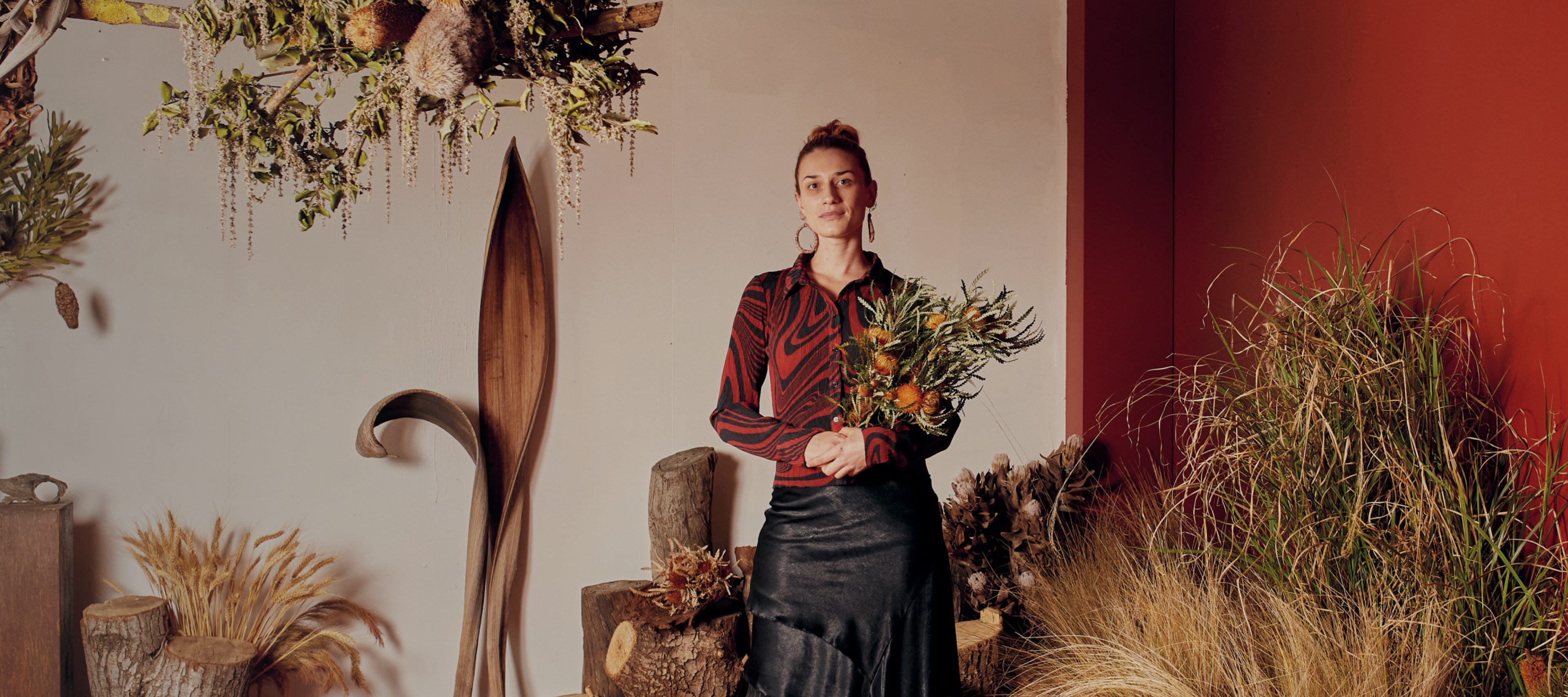
When Shahn Stewart visits her friend’s native flower farm on Yorta Yorta Country, she’s instantly drawn to the banksias. “I learnt they’re one of the oldest plant families,” says the botanical artist behind Melbourne’s Alchemy Orange. “They’ve adapted to the country.”


Shahn is referring to how banksias thrive and resprout in the face of fire, but it’s a metaphor you could apply to her, too. Shahn has worked as a florist for over a decade but launched her own business Alchemy Orange on the cusp of the pandemic in December 2019, which has only continued to thrive.


Finding beauty in the overlooked


“I see so much value in beautiful tall, long grasses, amazing straight stems and lush green leaves,” Shahn says. “Part of Alchemy Orange is shining a light on unconventional or everyday materials that are as overlooked as a piece of bark in an alleyway.”

“Part of Alchemy Orange is shining a light on unconventional or everyday materials that are as overlooked as a piece of bark in an alleyway.”

So even though Shahn’s a veteran of the 3am wake-up call that precedes early flower market visits, she is also passionate about sourcing native plants in a more traditional way.


“Foraging is a deeply rooted practice in Aboriginal culture. Indigenous people have been foraging for 60,000 years for both art and utilitarian purposes,” she says. “So I feel like I’m just following on that path.”


A sustainable approach to floristry


Foraging is a “very sustainable approach” says Shahn.


“Foraging is cutting that element: it’s already there and abundant,” says Shahn. It’s especially important as Alchemy Orange is an Aboriginal-owned business, and its founder never loses focus of that fact. “Essentially my work is Country, it is nature. It’s from Country, it’s grown on Country, it is Country. It goes hand in hand with my Yorta Yorta heritage.”

Making a statement with native plants and connecting to Country is something Shahn did with style at the recent National NAIDOC Gala event celebrating Indigenous achievement. By configuring candlestick banksias, long-leaf gum, dark tea-tree foliage and various types of eucalyptus throughout the venue, she illustrated how Alchemy Orange showcases the land in striking ways. One standout element on display was the sculptural macrocarpa eucalyptus, with its bright-silver surface. “It looks prehistoric, it looks like it’s from the dinosaur age,” she says.


The event was momentous, not just for cultural reasons, but because it was also Alchemy Orange’s second birthday. “It put into perspective what we had achieved in two years, and half of that was in lockdown – from bouquets to styling the National NAIDOC Gala event, it was huge,” she says. “We watched the event on TV and went, ‘that’s our work! That’s so cool!’”


A team effort


The ‘we’ in question involves Eden Fiske. Although Shahn initially began Alchemy Orange as a way to flex her creativity – especially after working for other floristry businesses where native plants played a minimal role – Eden is now a key part of her team and they recently staged their first all-Indigenous exhibition with Craft Victoria. They currently work together in a big warehouse in Preston. Fiske has a big painting studio on site, while Alchemy Orange has a studio upstairs.

“Someone once told me that if you pick a flower, that flower’s life ends with you. But thinking about the layers in paperbark, its story just continues – the layers are just never-ending.”

This creative bowerbird style reflects how Shahn works. While out foraging or at the flower market, she’ll notice some shapely bark or branches that draw her in. Or she’ll find grasses, nuts or berries she’ll collect on instinct, not knowing how she’ll use them. The Alchemy Orange studio is a storehouse for them until she works out where they belong.


The next chapter


Alchemy Orange’s work has been far-ranging, with plans to collaborate with mob in Larrakia Country in Darwin. Whether Shahn is planning for a wedding, corporate event or art exhibition installation, she relies on an “alchemy of these things” to accomplish the job: rough sketches, context from the client and inspiration from the landscape.


Shahn has found magic in everything from honey grevillea to possum banksia, but one material has really stayed with her: paperbark. Shahn recalls being drawn to the contrasting colours, textures and markings found on the paperbark surrounding her primary school.


“Someone once told me that if you pick a flower, that flower’s life ends with you. But thinking about the layers in paperbark, its story just continues – the layers are just never-ending,” she says. It’s an apt description for Alchemy Orange: Shahn’s unending curiosity with the natural world keeps leading to more chapters for the studio.

Learn more about Alchemy Orange here.


By Lee Tran Lam

Discover more from the world of Mercedes-Benz.