Before founding his eponymous studio, Phillip Withers grew up in the foothills of the Victoria’s Dandenong Ranges. The seeds of his eventual career in landscape architecture were subconsciously sown in these early years. A young Phillip would play in the surrounding bushland, and learn from his plant enthusiast grandma, who lived in a cottage on the multigenerational property.


A career in bloom


Unaware of landscape architecture as a career path, but with a keen interest in design and drawing, Phillip initially studied screen printing and founded a clothing label.


His interest in nature wasn’t explored until years later, when assisting a friend on a garden maintenance project. This job led Withers back to the Dandenong Ranges, both physically and metaphorically, where he rediscovered his passion for nature.


Phillip returned to study and honed his craft at other studios before founding Phillip Withers landscape architecture and horticulture studio in 2012. Now in its 10th year, the Melbourne-based studio comprises a dedicated team creating green spaces grounded in three key values: sustainability, productivity, and natural materials.

“Over 60 per cent of Victoria is privately owned, so a lot of that land is being developed and a lot of our grasslands and wildflowers are down to around one per cent,” Withers says.

Design pillars in practice


These three pillars of the Phillip Withers brand are multifaceted. When talking about sustainability, Withers is referring to a garden’s environmental impact (from the installation phase forwards) and the ability to be maintained on an ongoing basis.


When discussing productivity, he’s referencing the practical benefits of an outdoor space, as well as food production (what he calls the “pick and eat factor”) and regeneration of the native landscape.


Lastly, Phillip’s fondness of natural materials doesn’t equate to a purely native planting scheme, but integrating these into a considered material palette reflective of a site’s history, conditions, and the client’s own attachments.


Withers doesn’t have a ‘style’ per se although these principles show an overriding intent to create gardens with substance.


The creation of innovative show gardens, particularly in the studio’s early years, proved to be the perfect breeding ground to showcase Withers’ ideas. “They're the only chance that you can create your own brief and write it out and say, this is what we want to achieve,” he says. 

Creating regenerative spaces


Phillip Withers has now exhibited at six Melbourne International Flower & Garden shows, most notably winning the Gold Show Garden award and the City of Melbourne Award of Excellence for Best in Show for ‘I See Wild’ in 2017. A celebration of biodiversity, this 200 square metre no-waste garden combined leafy greens, oversized succulents, and fruit trees around hand carved stone paved areas.


Aesthetically, ‘I See Wild’ demonstrated the studio’s talent for integrating texture, balancing structure, and considering every inch of a site’s ability to contribute. “We want to make sure there’s a whole lot of use, so rather than just designing a path, it's about what we can pick on the edges of those paths—whether it be some herbs and smaller fruits like strawberries,” Phillip says.


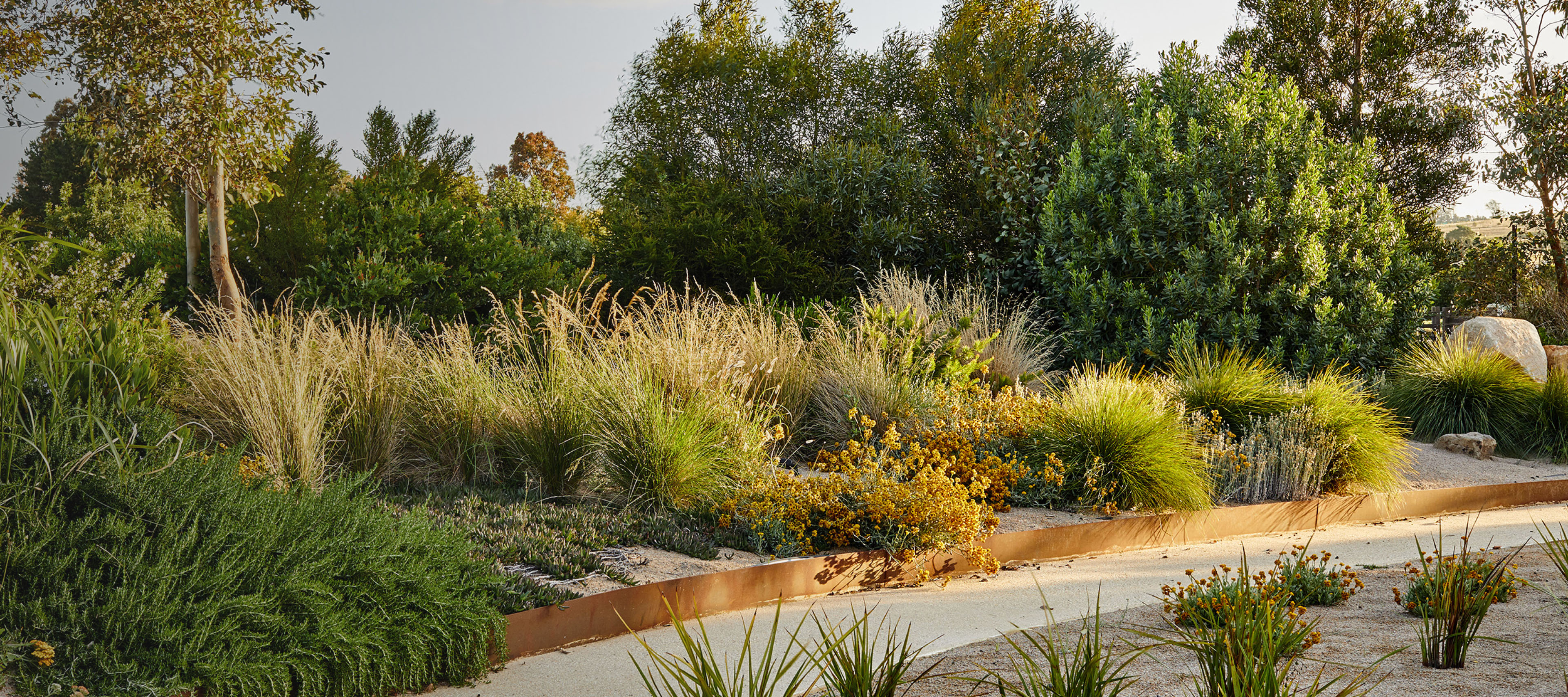
Regenerating Australia’s natural landscapes is also integral to Withers’ work, particularly considering the growth of outer suburban and regional housing developments. The studio’s project for housing estate Austin in Lara (a town north-east of Geelong), for example, has helped instil the area with bird and plant life abundant in the nearby You Yangs Regional Park by reintroducing a 90 per cent Indigenous planting scheme.

“We want to make sure there’s a whole lot of use, so rather than just designing a path, it's about what we can pick on the edges of those paths—whether it be some herbs and smaller fruits like strawberries.”

“Over 60 per cent of Victoria is privately owned, so a lot of that land is being developed and a lot of our grasslands and wildflowers are down to around one per cent,” Phillip says. “We really need to be conscious when we're moving forward in terms of how much of our landscape we’re making sure we are regenerating.”


On the completion of a job, Phillip hopes his clients feel closer to nature. “We want them to basically get that further connection to the landscape,” he says.


“It’s giving them the power to have a space that's enriching their life, and also enriching the locality.”


Five ways to sustainably garden at home with Phillip Withers

1. A sustainable garden is one that’s conducive to your lifestyle. Start to determine how many hours you can spend on upkeep each week to keep your garden functioning long term.
2. Harvest and reuse rainwater in your garden by integrating a pond or water feature to support relaxation and attract wildlife.
3. ‘Right plant, right place’ is the golden rule for encouraging optimum plant growth with minimal upkeep.
4. Find practical and multipurpose uses for natural materials, such as carving a rock into a bench seat or bird bath.
5. Consider your garden as a closed loop system where plants and materials are recycled, regenerated, or composted.

By Amelia Barnes