Calling all lovers of sustainable design and automotive innovation: the Bridgestone World Solar Challenge (BWSC) will be held in Australia this August.


Heralded as the world’s greatest innovation and engineering challenge, the biennial BWSC was established in 1987 to push the limits of technological innovation and inspire young people to “address the imperatives of sustainable transport”.


There are three classes: challenger; cruiser (which explores the real-world applicability of solar-powered vehicles); and explorer (a non-competitive class showcasing cars designed for a previous event).


In 2025, 34 teams from 18 countries will participate in the gruelling challenger class, driving around 3000km and navigating tricky terrain in solar-powered vehicles they designed and built themselves.


In previous years, the BWSC was held mid-October, but the new 2025 dates from August 24–31 mean there will be 20 per cent less sun when the solar cars make their long journey.


In the lead up to the endurance race, we caught up with German contenders Team Sonnenwagen Aachen, who are supported by Mercedes-Benz, to hear about their race preparations.


Team Sonnenwagen Aachen


A student initiative from Aachen, Germany, Team Sonnenwagen Aachen is comprised of 44 members from RWTH Aachen University – a highly recognised technical university in Europe – and FH Aachen University, which specialises in applied sciences.


During the last BWSC race in 2023, Team Sonnenwagen Aachen suffered a massive disappointment when side winds from an oncoming road train pushed their car – Covestro Adelie – off the road, flipped it over, and disqualified them just 300km from the finish line.


“Imagine that, in a super-light car on the road where you're sitting quite low,” says the team’s technical co-lead Christian Behrends. “You know those road trains when they're transporting those [overhanging] houses? Sometimes our car is lower than the whole house!”


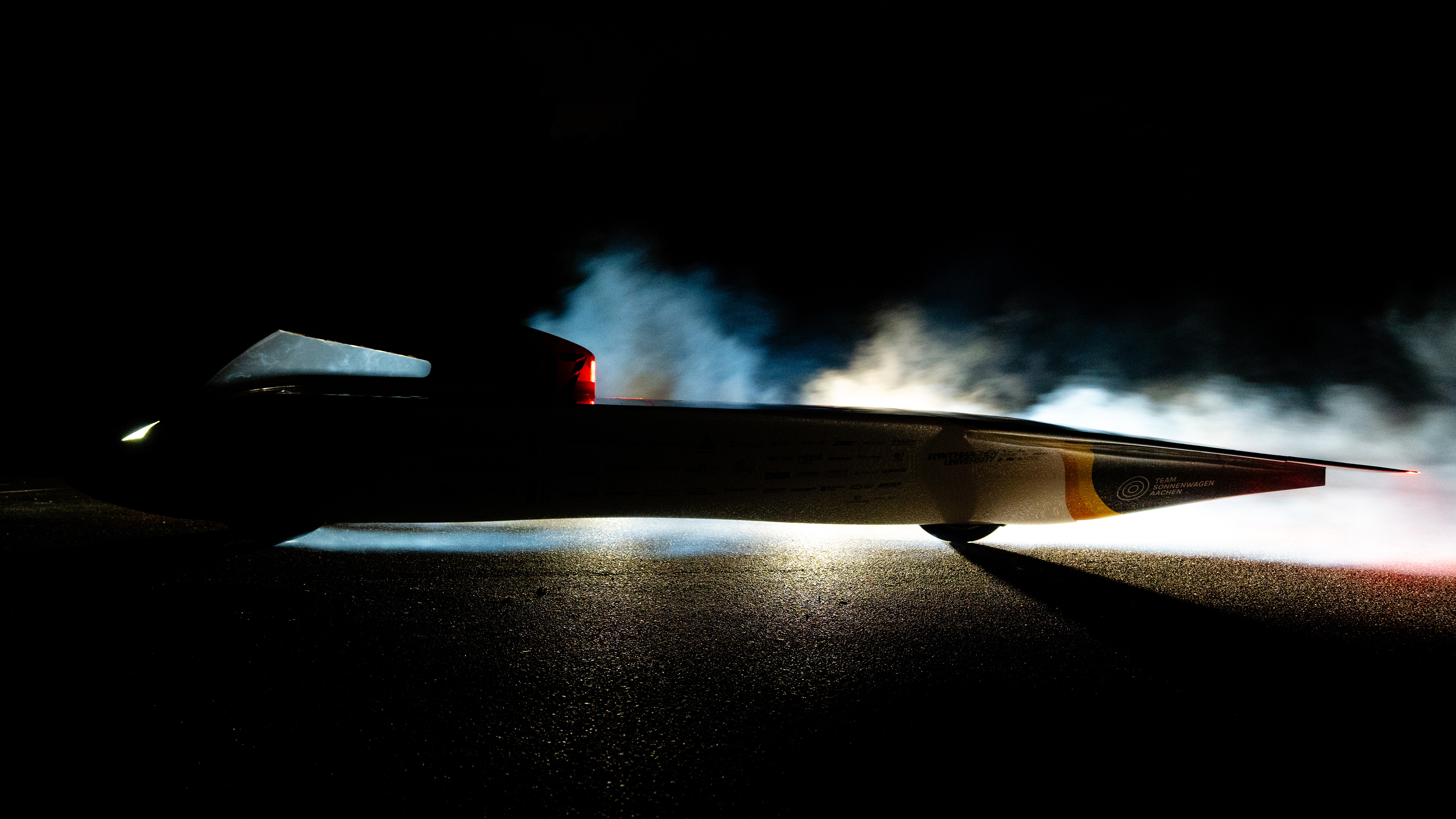
Determined to go the distance in 2025 with their new vehicle (named Covestro Aethon), Team Sonnenwagen Aachen has a renewed focus with hopes of finishing in the top five.

A new solar car to beat aerodynamic drag


This year, the team looks to overcome their biggest adversity: wind.


“Our biggest losses are aerodynamic losses, and we do everything we can to minimise those,” says Christian. This meant building a bullet-shaped solar car and reducing the frontal area as much as possible, “so you have a good flow of the air around the car”.


The vehicle is made from lightweight carbon fibre and high-strength aluminium used in aerospace design. It weighs 170kg with a sleek, 5.8m-long exterior and a battery capacity of 3kW/h.


The team has strategically positioned their permitted six square metres of solar panels at the rear of the vehicle to maximise sun exposure. Along the route, nine mandatory checkpoints allow for driver changes and give the team a 30-minute break to charge the car.


Speed and efficiency are obviously major technical considerations – often at the expense of the drivers’ comfort. “Because everything is done for efficiency, the comfort part of the car is really minimal,” says driver Felix Nupnau Perez. “We don't have air conditioning, so it can get really hot, especially around Darwin.”


Race preparations, testing and strategy


Team manager Leonie Brandt says Mercedes-Benz has been integral to their race preparations, which began two years ago.


“Every two weeks, we had a call with the Mercedes-Benz project team,” she says. “They gave us technical input and oversaw our designs, especially in the electrical department.”


Team Sonnenwagen Aachen also spent three days with their solar car and convoy, which includes a Mercedes-Benz V-Class, at the Mercedes-Benz Testing and Technology Centre in Immendingen – a track with 30 different test circuits.


“We did additional wind testing this year to ensure driving stability,” says Leonie, “but it is a very complex problem because you can’t really predict how the car is going to perform.”


Importantly, the team was able to test the vehicle at the Mercedes-Benz wind tunnel in Stuttgart, which Leonie describes as “critical” because it allowed them to test the car’s aerodynamic performance and determine drag.


Beyond the race


For many students, the BWSC is a huge professional opportunity, and many alumni have landed careers in the engineering and sustainable automotive space. Another bonus of the challenge is meeting like-minded people.


“We're learning so much being at Sonnenwagen,” says Leonie, who embraces the practical aspects of “working in a team, communicating, and just taking responsibility and actually doing a project”.


Leonie, Christian, Felix and the rest of the team have dedicated hours of time and energy alongside full-time study – so why come back a second time? “I mean, when can you get to go to Australia with 44 people and drive around with your self-built solar car in the Australian outback?” says Leonie, “It is a pretty crazy project and it’s a lot of fun.”


Watch this space: we’ll be talking with Team Sonnenwagen again after the race to hear about the thrills as the BSWC unfolds for 2025.


Follow the World Solar Challenge journey.

Discover more from the world of Mercedes-Benz