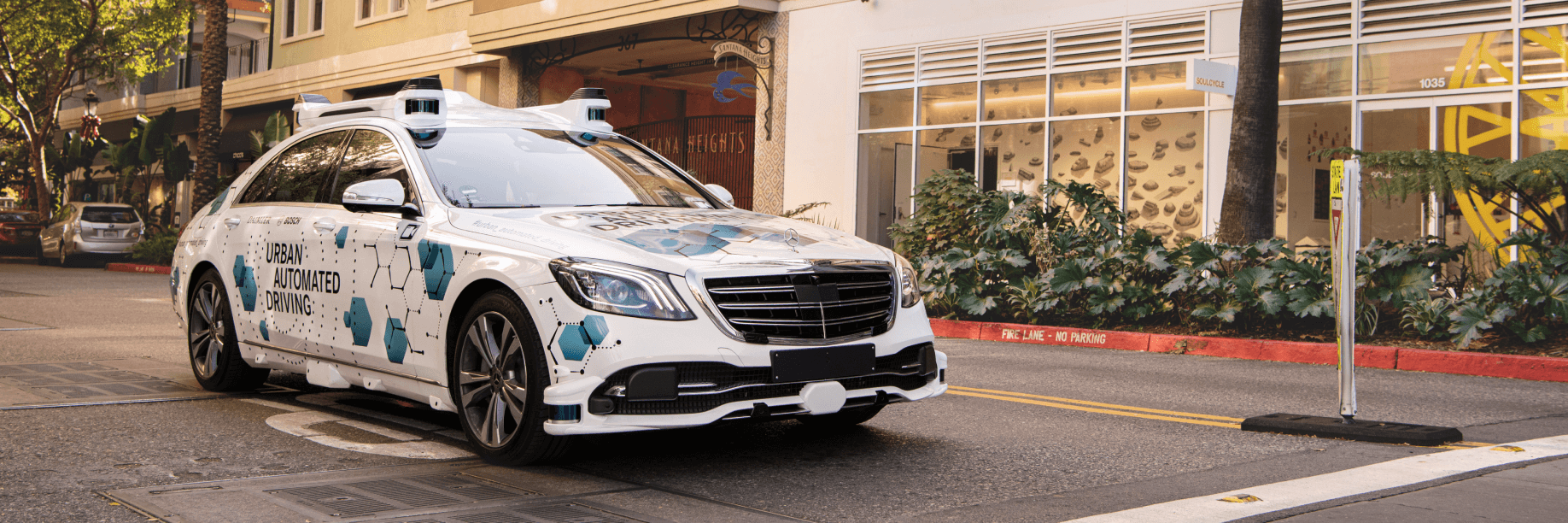
Mercedes-Benz and Bosch have teamed up to pilot test fully autonomous vehicles in San José. Image: Supplied.
;Resize=(828,828) "On the streets of San José")
How autonomous cars could change our lives.
5 March 2020
Autonomous driving could have an unprecedented impact on our future. We will feel the effects of this groundbreaking technology in the tiny details of everyday life as well as in the big issues of the day, such as transport infrastructure, life in the city and the economy. The expectations, indeed, the hopes, that go with autonomous driving are enormous.
And it’s already well advanced in its development. Cars manoeuvring themselves through the world on their own, while we lean back inside and turn our thoughts to something other than the traffic, are within reach.
Digital transformation
There are still some hurdles to overcome – technological, of course, but also legal questions surrounding liability and ethics. For example, how do you evaluate possible wrongdoing in other road users? In other words: how does a computer-controlled vehicle become a careful, responsible road user?
Uwe Keller, head of Autonomous Driving at Mercedes-Benz AG, nevertheless sounds confident when he says: “We are working to bring the technology to production readiness in the near future.” The competition has been fired up for a while now as digital companies such as Google and Apple are directly competing with traditional car manufacturers such as Mercedes-Benz.
In an effort to drive development forward as comprehensively and speedily as possible, Mercedes-Benz is working closely with suppliers, but also with universities and even competitors such as BMW. After all, automated and autonomous driving heralds a fundamental change in mobility. “We are setting new boundaries with the project in terms of software development,” explains Keller. “Our work on automated and autonomous driving is a testament to the transformation that companies like Mercedes-Benz AG are currently undergoing. Although we are still a company whose reputation is rooted in classical mechanical engineering, we are turning more and more into a software developer.”
Because alongside meticulously constructed and designed vehicles, digital technologies, algorithms, neural networks and data collections are integral elements in making automated and autonomous driving part of everyday life.
We will all be passengers
Let’s take a step back: When we talk about automated and autonomous driving, what exactly are we talking about? Consensus has been reached in Australia, Europe and the USA on six levels, which are:
Automation level 0:
The car is driven by the driver.
Automation level 1:
Assistance systems such as Distronic proximity control support the driver.
Automation level 2:
Functions such as Active Parking Assist or Active Stop-and-Go Assist enable partial automation.
Automation level 3:
The vehicle carries out autonomous actions such as indicating, changing lanes and keeping in lane. The driver is asked to take over if necessary.
Automation level 4:
With this full level of automation, the vehicle operates automatically in certain situations (e.g. in a park house or in particular districts). From a technical standpoint, the driver does not necessarily need to take action.
Automation level 5:
The driverless vehicle does not require a driver at all. Passengers can focus on other things than traffic.
The higher the figure, the more advanced the degree of vehicle automation. Autonomous driving is designated as level 4/5 – the highest levels. A good example of this is the Robotaxi, currently being trialled in parts of Asia and the United States. You order this just as you would a normal taxi, except there is no driver in the vehicle picking you up. It steers through traffic independently, bringing you easily and comfortably to your destination, no matter how far the distance.
The gift of time
The advantages of automated and autonomous driving are self-evident, not only for customers of services such as Uber or 13cabs, but also for private owners who will no longer need to focus in stop-start traffic or when driving on holiday.
Sometime in the future, drivers will switch their Mercedes-Benz into autonomous mode and become passengers: with this comes the possibility to work in the car, turn the seats around and talk face to face with friends or family, potentially shop online, watch films or pick from the best restaurants that the destination has to offer. Eventually, the car will let us out in front of the restaurant and will leave to look for a parking space.
One of the most compelling arguments for autonomous driving is that it gives us the gift of time, and with this comes a new freedom. This freedom comes from being able to do as we wish with our time on the journey, but also because it means our mobility is becoming even more flexible. Parents could possibly even have their children picked up from school by a self-driving car if work takes longer than expected. Automated and autonomous driving could also enable older people or people with disabilities to participate more fully in society.
Complex tasks
The technology is set to make using roads much safer. When vehicles are driving autonomously and communicating with each other, fewer accidents will occur – at least, that’s the expectation. After all, the number one source of error in traffic is that of humans.
Even so, the human brain manages complex tasks, the solution of which even the most intelligent algorithms have yet to master. “We are factoring in a very wide range of scenarios,” says Keller, “playing through all permutations of possible decisions. What does the computer have to consider in which situation?”
Seamless interaction is crucial: how the sensors on the car perceive the environment, general traffic data, past experience, factors such as the weather, the time of day – the list is long. Lately, though, progress has been rapid. “When I look at what’s possible today, it’s incredible. Twenty years ago, I couldn’t have dreamed of this,” says Keller enthusiastically.
Today, assistance systems for drivers of Mercedes-Benz vehicles are already part of everyday life – and this is the second level of automation. Under the supervision of the driver, the Active Parking Assist parks the car and the Active Stop-and-Go Assist keeps a constant watch on congestion. The potential for series production applications is ever increasing.
Worldwide development
It’s no wonder that the world’s largest corporations are investing enormous sums in these developments, and, in the same way that Mercedes-Benz is doing in Germany, USA, China and India, they are moving the technology forward with a wide variety of partners.
There are different areas of application and different expectations. People’s demands are multifaceted and diverse – whether it’s about traffic regulations, cultural customs or the user’s habits. The same applies to the level of acceptance of automated and autonomous driving: in many Asian countries, for example, new technologies are much more readily embraced than in Europe.
At Mercedes-Benz, the first application examples – meaning the ones that have made it beyond the testing phase – are expected before the mid 2020s. Mercedes-Benz has already started field testing an automated driving service that works without the use of pedals or a steering wheel in San José.
The company has been testing exactly what we have described above: the user calls their vehicle by app, just like ordering a taxi. Except that this vehicle is driving itself. There will still be a driver behind the wheel to intervene in case of emergency and an expert who explains the technology to passengers.
Hand signals and eye contact
These are the essentials for a brand like Mercedes-Benz when it comes to making innovations fit for everyday use. What do customers expect from a car without a driver? Do we need a voice that welcomes us? Do we prefer to talk to the vehicle, or do we want to interact via screens or buttons?
“Today, a taxi driver deals with many situations using eye contact or hand signals,” says Thomas Hengstermann, head of Autonomous Services at Mercedez-Benz Mobility AG and responsible for transforming the technology into actual products and services. “The driver might ask the guest: Have you fastened your seat belt? How are you today? Are we ready to set off? What this means for us then is: how can we build up people’s trust so that an automated trip becomes a fulfilling all-round experience?”
It is not yet clear how customers will receive the technology offered by all the different suppliers. At Mercedes-Benz, though, we naturally strive for quality and the highest possible safety standards – familiar qualities that have always been inextricably linked with the brand. The same standards which will also distinguish an automatedly driven Mercedes.
“We are taking it slowly,” says Thomas Hengstermann. “But our timetable has been set.”
Our series will continue! In the second part, we will be focusing on the technologies that make automated and autonomous driving possible in the first place.