Portrait of Stephen Jones, British Milliner, with Vivienne Westwood, Ensemble, 1987, Harris Tweed collection, autumn-winter 1987–88, in Westwood | Kawakubo on display from 7 December 2025 to 19 April 2026, at NGV International, Melbourne. Photo: Eugene Hyland
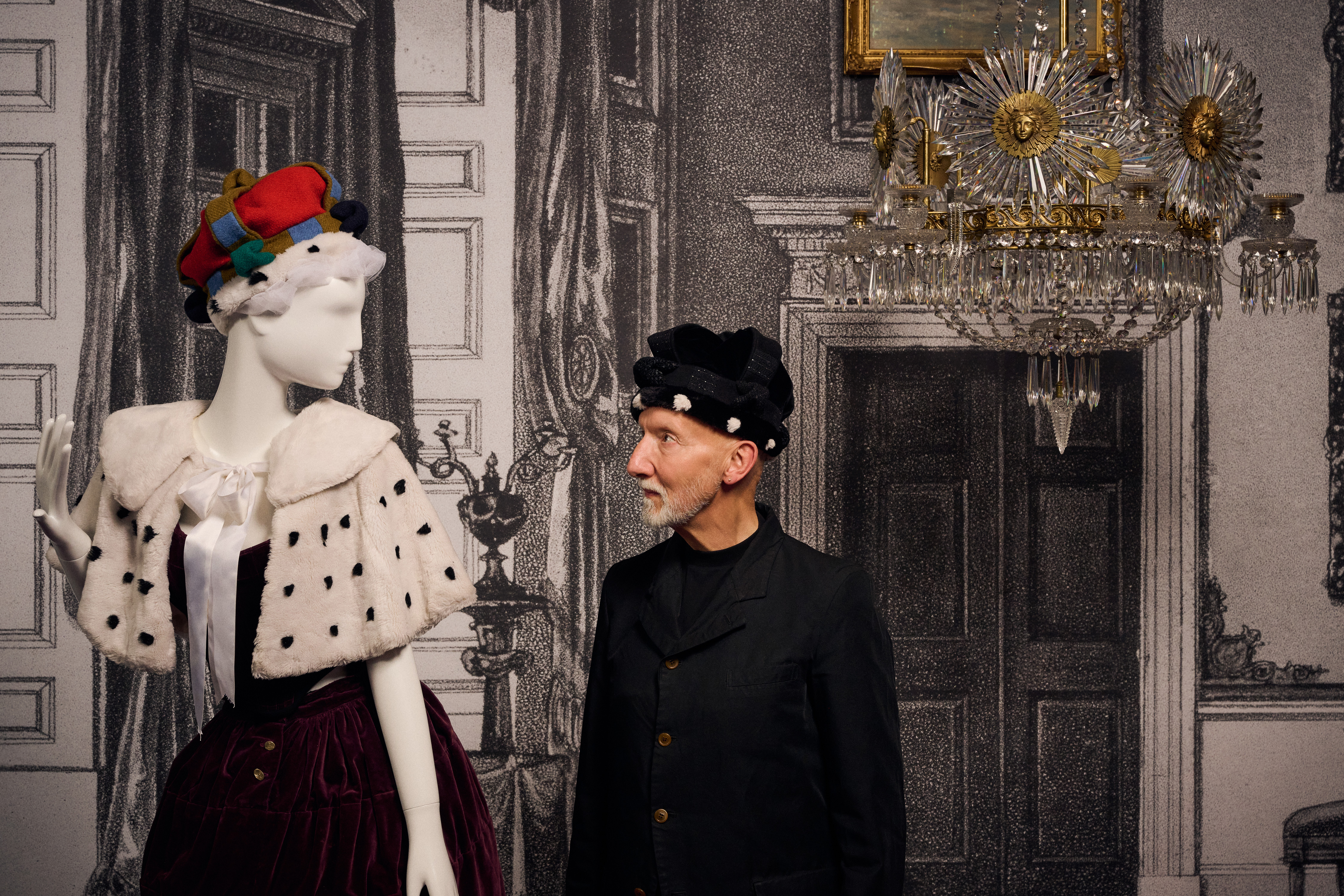;Resize=(828,829) "A bearded man in a hat, milliner Stephen Jones, looks at one of his designs for Vivienne Westwood.")
Hats that turn heads: the intricate millinery of Stephen Jones.
British milliner Stephen Jones has created hats for the world’s greatest fashion designers and a roll call of celebrities. In Australia for the opening of NGV’s Westwood | Kawakubo exhibition, he speaks about his distinguished 50-year career.
January 2026
They say the devil is in the detail, and at Melbourne’s NGV International, the curators of Westwood | Kawakubo have spotlighted a striking link between these two radical designers: the innovative works of British milliner Stephen Jones.
Having worked with both Vivienne Westwood and Rei Kawakubo throughout his career, Stephen has created a swathe of display headpieces for the NGV’s world-premiere exhibition.
“I've known Westwood and Kawakubo for a very long time, and their work, so they were always an inspiration to me,” Stephen says, “But I think specifically when I was working on this exhibition, it was the clothes themselves that helped me decide what I wanted to do.”
Designing the headpieces was a long and involved process, requiring Stephen to go back through the archives of both designers. “We tried to connect the outfit that the mannequin is wearing [with] maybe what they wore in the show or in real life, and also the decor of this incredible exhibition,” he explains. “The function of [each headpiece] is to clothe the head, not to have an identity of its own, so they’re a little bit invisible as well.
“I’ve made nearly 50 headpieces for this exhibition, each one a different theme, each one a different material. It’s been quite an adventure.”
The milliner’s five-decade career is full of unforgettable, boundary-pushing designs and legendary collaborations, most notably with Westwood and Kawakubo.
The making of a milliner
After college, Stephen interviewed with different designers but ended up driving a fruit delivery truck for his father by day and making hats for stylist Kim Bowen by night.
“I came down to London one day, opened up the back of my car and said, ‘Kim, here are 15 hats for you,’” he told System Magazine. “This was Spring 1980, a year after leaving college.
“She wore them out and about and Steve Strange saw them. He was working at [boutique] PX… he said they had a basement they weren’t using and asked if I’d like it. So, on October 1, 1980, I opened my own little shop.”
“She broke down all those things that we thought were clothing and created something new.”
There, Stephen sold hats to people from all walks of life. Later, Boy George would ask him to be in the video for ‘Do You Really Want to Hurt Me?’, which brought more opportunities with it.
“I was wearing a fez and when Jean Paul Gaultier saw the video he asked me to model in his first men’s fashion show. But I fell off my brother-in-law’s motorbike, and I couldn’t be in the show. When I visited Paris a few months later, Jean Paul showed me a film of it and asked me if I wanted to do hats for his women’s collection.”
Among Stephen’s best-known pieces are Egyptian-style designs he created for John Galliano’s Dior haute couture spring/summer 2004 show, with whom he shared a decades-long partnership, beginning in the 1980s and continuing through the visionary fashion designer’s tenures with Christian Dior (where Stephen remains creative director of hats) and Maison Margiela. He also has other long-standing collaborations – with Schiaparelli and Thom Browne, for example – while still creating his own collections at least twice a year.
Since his earliest days as a milliner, celebrity clients – including Kylie Minogue and David Bowie – have been abundant. But there is one that Stephen holds in particularly high regard: Her Majesty Queen Elizabeth II. For his 2009 V&A exhibition, Hats: An Anthology by Stephen Jones, Stephen asked the Queen to lend a Hermès scarf and hat from the Queen Mother’s collection, worn on her 100th birthday.
Working with Vivienne Westwood
Vivienne Westwood epitomised punk in London during the 1970s. She and Malcolm McLaren owned a boutique called SEX on King’s Road but, as a student, Stephen was scared to enter. “Because I was a fashion student, I was the lowest of the low,” he told AnOther Magazine. “So I scampered off with my tail between my legs.”
He met Westwood soon after, in 1978, and they began collaborating after he held a private showing of his hats for her. Stephen recalls, in the late 1980s, "she said, ‘I’ve got this idea of doing some crowns out of fabric,’ and she told me about the tweed, and I said, ‘Oh, we can make crowns out of tweed’. We worked on the pattern and I developed a sample.”
Those pieces would become part of Westwood’s autumn/winter 1987–88 Harris Tweed collection, examples from which are on display at the NGV exhibition.
“At the beginning of her career… nobody had ever seen clothes like that before,” he tells us. “She really, at a time of punk, broke down all those barriers, broke down all those things that we thought were clothing, and created something new.”
“How great if rebellion can be just a hat.”
Working with Rei Kawakubo
Stephen has a working relationship with Rei Kawakubo that extends back to 1985: “…it was strange because I was making hats for Diana, Princess of Wales and for Comme des Garçons at the same time,” he explained to Vogue.
“I remember sketching it and thinking, ‘Well, it needs to be a beret, but off-kilter, because that is what she [Kawakubo] seems to be doing. She is doing a jumper with two sleeves on it – but it’s got holes in it.’”
Stephen has great admiration and respect for Kawakubo and what she’s created. “What she has done is extraordinary, she’s taken clothing to places that you didn’t imagine it could go,” he tells us.
It was this sense of rebellion – from both designers – that Stephen drew on to help him craft the headpieces for Westwood | Kawakubo. He describes their approach as “rebellion against the status quo”, and being “dissatisfied with something that’s out there already and you just think you have to do something better or do it your own way”.
“When I’m making a hat… I’m just trying to find a beautiful or an original way to express something, which other people might interpret as rebellion,” he says.
“How great if rebellion can be just a hat.”
Mercedes-Benz is Principal Partner of Westwood | Kawakubo, on display at NGV International, Melbourne, until April 19 2026.
Visit the Westwood | Kawakubo exhibition at the NGV.