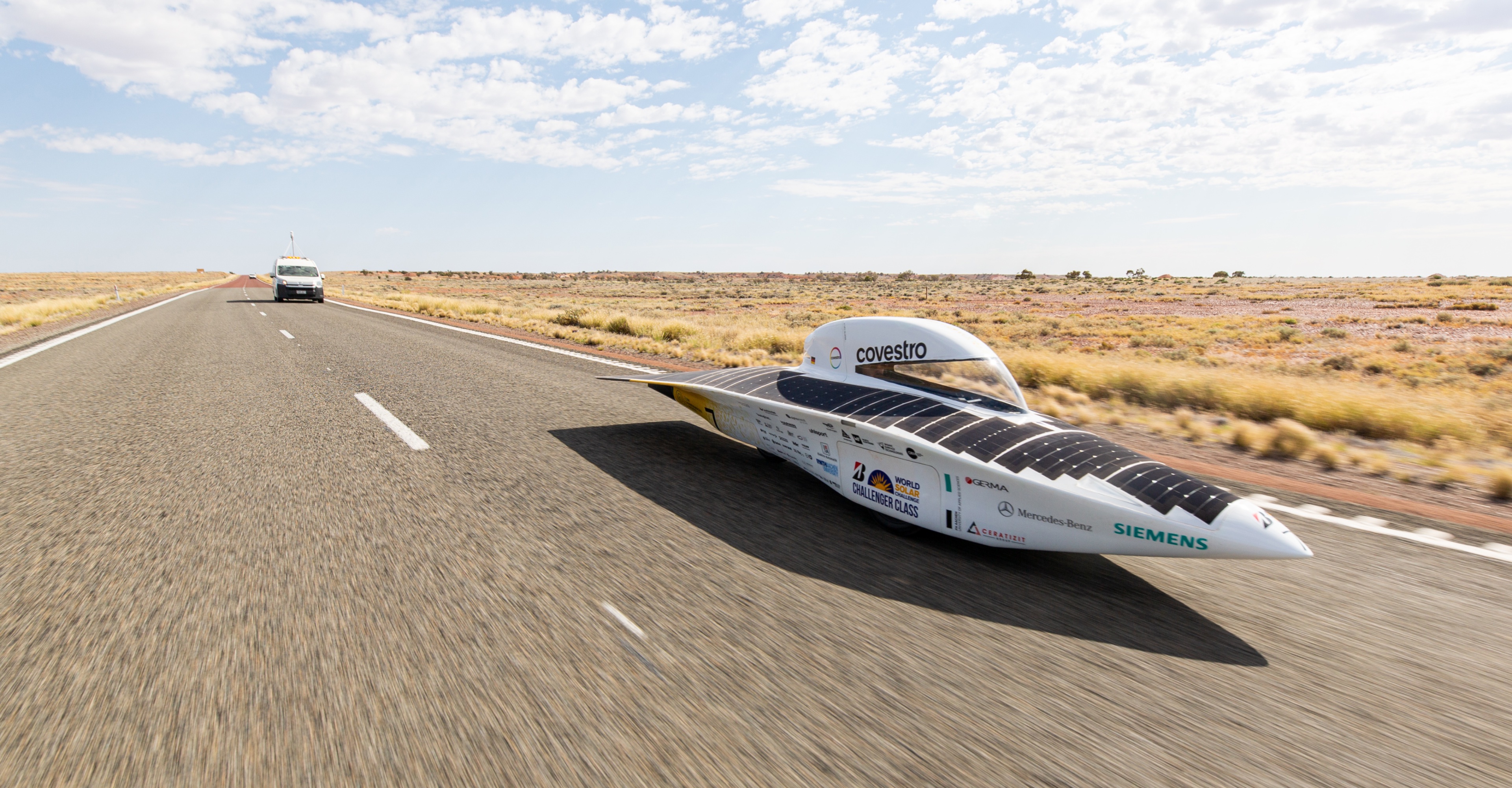
Imagine building a vehicle from scratch and taking it on a 3000km road trip from Darwin to Adelaide. Oh, and there’s a catch: the vehicle must be powered solely by the sun.


Incredibly, a young team of tertiary students from Aachen, Germany did exactly that. The student initiative goes by the name Team Sonnenwagen, and with the support of Mercedes-Benz, they raced their self-built vehicle Covestro Adelie in the Bridgestone World Solar Challenge.


World Solar Challenge


The Bridgestone World Solar Challenge is considered to be the largest and most prestigious solar car race in the world. Since 1987, the biennial event has invited teams from around the world to push the boundaries of energy efficiency and vehicle technology by designing, engineering and building their own solar-powered vehicle.


Vehicles can be entered into one of three classes. The challenger class involves racing from Darwin to Adelaide in a single stage; the cruiser class tests advanced concept cars and how they manage their energy requirements over three 1000km stages; and the adventure class is a non-competitive class intended for cars designed for a previous event.


As the original concept, the challenger class is all about efficiency and endurance. Each day of the race, the teams travel as far as they can until 5pm (Northern Territory time) and then make camp wherever they may be in the outback. They must also be highly strategic in planning their route – driving through everyday traffic and battling unpredictable weather as they inch closer to the finish line.


Over the course of the journey – which takes approximately five days to complete – there are nine mandatory check points where only basic maintenance can be performed: checking tyre pressure and cleaning debris from the vehicle.


Team Sonnenwagen Aachen


For the 2023 race, 38 teams from 22 different locations participated, including several Australian teams from universities such as Flinders University and the University of Adelaide.


Team Sonnenwagen also took part with their custom-made vehicle, Covestro Adelie. This is the fourth solar car the team has designed and third time they’ve participated in the Bridgestone World Solar Challenge since their inception in 2015.


“Team Sonnenwagen was born on a cosy evening in a shared apartment in 2015. It was here that we were struck by the ambition to build a solar racing car to take part in the World Solar Challenge in Australia,” says team member Leonie Brandt. “Since then, we have been developing an innovative solar car every two years, using the latest technologies and our own ideas to push what is technically feasible to the extreme.”
 

“… [we are] using the latest technologies and our own ideas to push what is technically feasible to the extreme,” says Leonie.

Inspired by Antarctic’s Adelie penguin, Covestro Adelie is optimised for aerodynamic efficiency and was two years in the making. The three-wheeled vehicle has a total weight of less than 170kg and a top speed of 136km/h.


"The concept of the fourth generation of our solar car is based on an aerodynamic outer shell, efficient electrical engineering and extremely lightweight construction," says Leonie.


The team’s objective was to minimise air resistance and energy consumption. To achieve this, they developed 600 models and more than 200,000 computational hours for the simulations before the exterior model for Covestro Adelie had been developed.


“Aerodynamics was a top priority for us since low air resistance allows us to reduce the energy consumption of our racing vehicle to a minimum,” explains Leonie.

From there, the structural, electrical and mechanical engineering teams began the manufacturing process.


"Over 10,000 workshop hours, around 70 milled parts and half a year later: Covestro Adelie's body [was] manufactured," says Finn Möller-Boldt, head of structural components 2023 of Team Sonnenwagen.


Supported by Mercedes-Benz


Once the solar car was manufactured, Mercedes-Benz supported the young engineers by inviting them to test the aerodynamics of Covestro Adelie at the wind tunnel at Mercedes-Benz in Stuttgart.


Conscious of the extreme heat on the route from Darwin to Adelaide, where temperatures can exceed 40°C, Team Sonnenwagen installed a NACA duct as “an air intake in the front cockpit” to provide their driver with energy-saving air conditioning and were keen to put this new feature to the test.

“…reliability is crucial. That is why we drove almost 2200 test kilometres in Germany,” says Leonie.

“Thanks to our time in the wind tunnel, we were able to test this innovation and evaluate its practical benefits for future developments,” explains Leonie.


Determining the reliability of the Covestro Adelie ahead of the 2023 race was also crucial in the development process. Mercedes-Benz offered further support by inviting Team Sonnenwagen to use the test track in Immendingen, Germany.


“In a race lasting several days in the harsh conditions of the outback, reliability is crucial. That is why we drove almost 2200 test kilometres in Germany,” says Leonie.


“Here, we checked the electrical components in the solar car… we also practiced initial race simulations in the team, such as driver change.”


A promising start


Making the journey from Germany to Australia, Team Sonnenwagen started the race in pole position after achieving the fastest qualifying hot lap at 1:56 minutes.


The first four days of the race went smoothly without experiencing a single technical issue, which Leonie attributes to the many days the team spent testing the vehicle. However, at 2734 kilometres – approximately 300 kilometres from the finish line – the unexpected happened.


“Due to strong crosswinds and oncoming trucks, our solar car ended up off-road. We were disqualified from the race,” says Leonie.


Though the driver was unharmed, and the vehicle remained in good condition, it was an untimely end after a promising beginning. Ultimately, the team were united by their greatest achievement – the two years it took them to get ready for the race – and were permitted to symbolically cross the finish line in their solar car.


“…we are not giving up,” says Leonie. “We’ve learnt a lot in the last few years and will return to Australia in 2025.”

Discover more from the world of Mercedes-Benz.