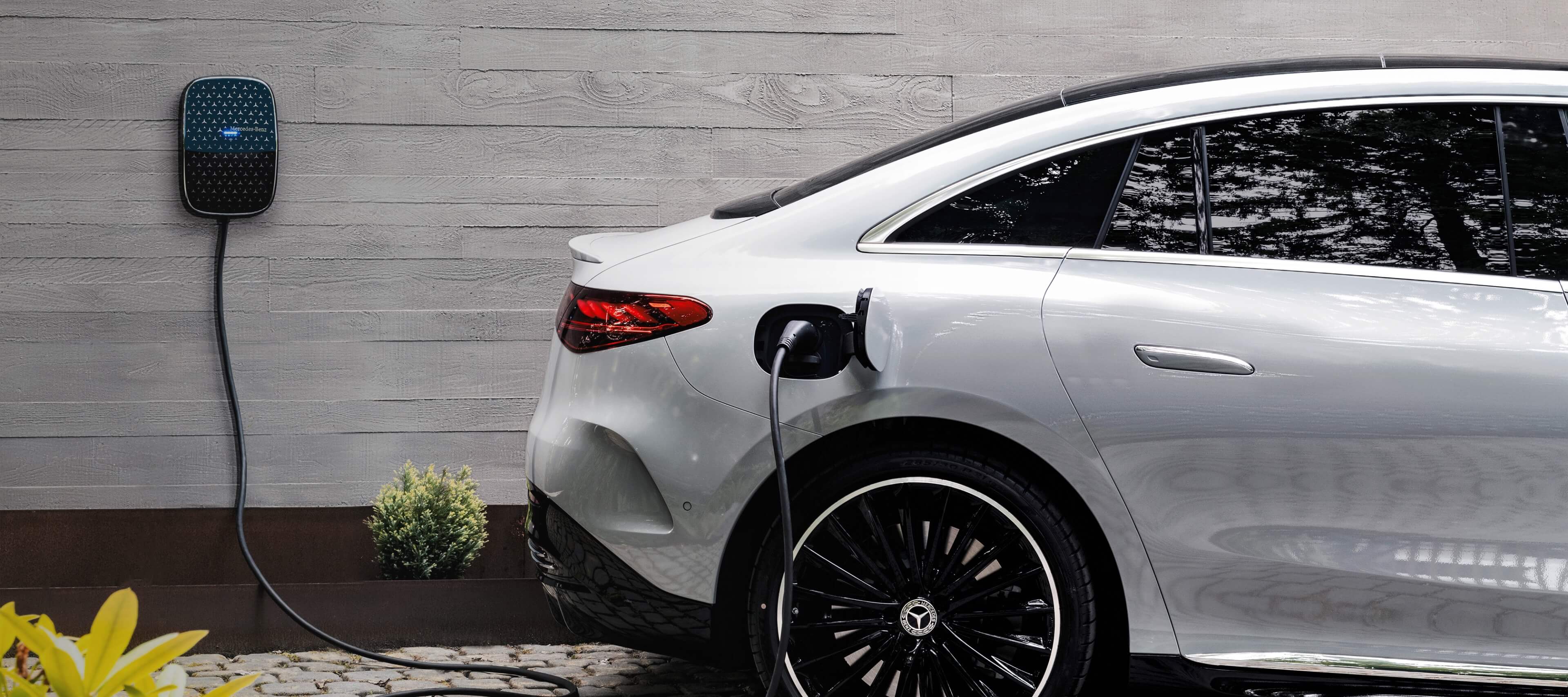
;Resize=(828,828) "EQS from Mercedes-EQ charging")
The electric vehicle (EV) may seem like a recent technological advancement in the field of transport, but it’s been around a lot longer than you think.
The first primitive battery-powered vehicles emerged in the late 19th century and were able to travel extremely short distances before the batteries died and were simply disposed of. It wasn’t long before innovators began exploring the concept of rechargeable batteries – Thomas Edison is credited with building one of the earliest electric vehicle charging stations at his home in New Jersey in 1908.
Modern-day electric vehicles, such as those in the Mercedes-EQ range, are powered by high-performance lithium-ion batteries that can be recharged using several different methods, whether you’re at home or on the road.
How are electric vehicles charged?
EV batteries are charged using either alternating current (AC) or direct current (DC) electricity. While electricity from the grid is delivered as AC, present-day battery systems will only accept DC electricity, which is why all EVs have an AC/DC rectifier on board to convert AC power to DC.