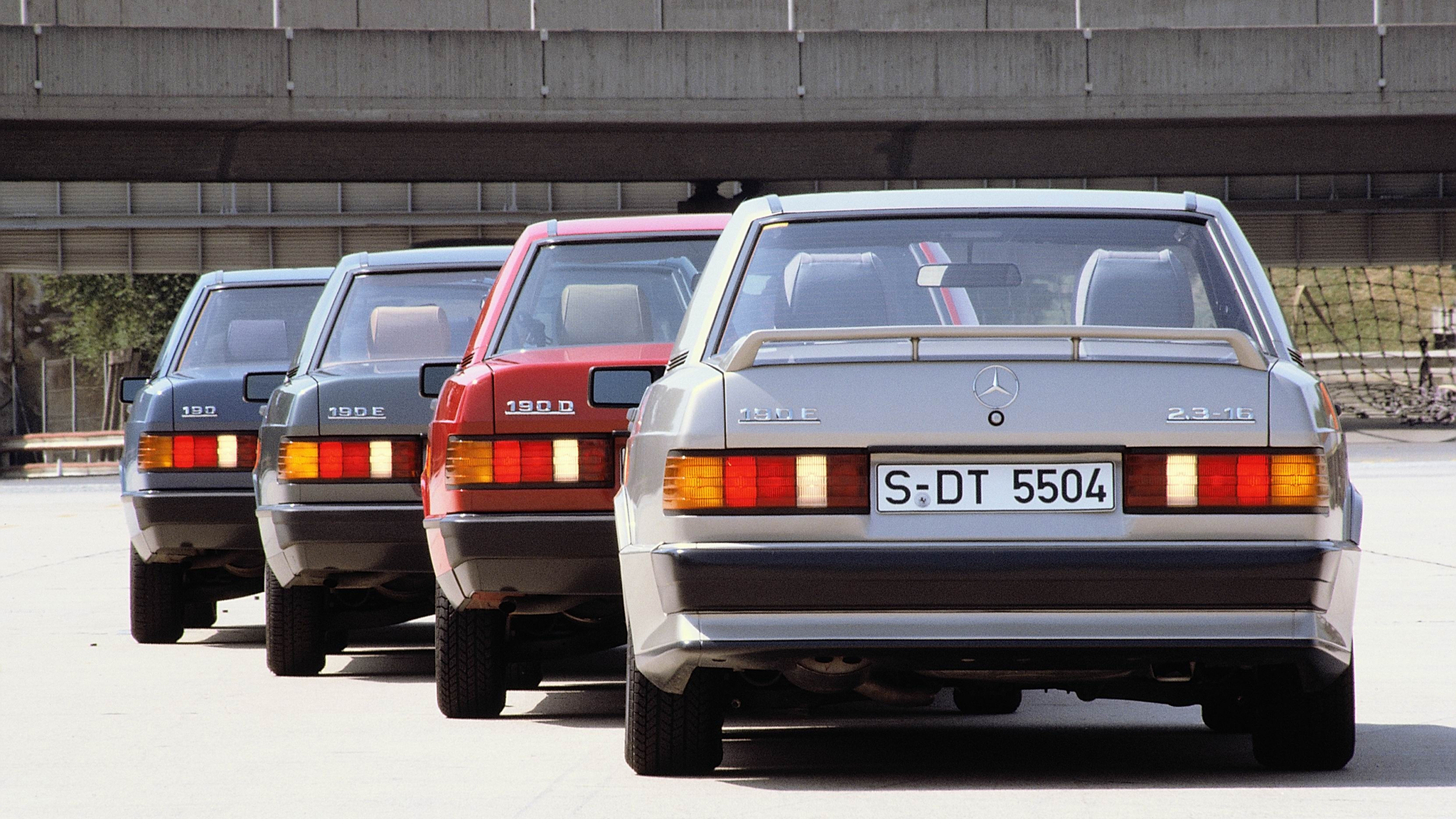
Launched in 1982, the 190 model was the predecessor of the C-Class and the first Mercedes-Benz to be referred to as “compact class”. Image: Daimler.
;Resize=(828,828) "Mercedes-Benz W 201 series")
All class: the evolution of the Mercedes-Benz C-Class.
The C-Class has come to define the compact luxury segment. We look back over five generations to map its journey to the top.
24 November 2021
The arrival of a new Mercedes-Benz C-Class is always a big deal. Not merely the cornerstone of the modern Mercedes-Benz passenger vehicle portfolio, the long-running C-Class is also the yardstick against which other brands measure themselves.
Ahead of the arrival of the all-new model, known as W 206, it’s a good time to reflect on how the C-Class rose to the top of the compact luxury class.
Origins: W 201 (1982 – 1993)
The forerunner to the C-Class, the Mercedes-Benz 190 series was launched at the 1982 Paris Motor Show. Its elegant, proportional styling from legendary designer Bruno Sacco shifted the goalposts for luxury saloons and set the template for the modern C-Class that was still a decade away.
It featured a patented multilink rear suspension, front and rear anti-roll bars, plus anti-dive and anti-squat geometry. Reinforcing the marque’s already strong track record for safety, the 190 was constructed from lightweight, high-strength steel that could hit a concrete barrier at 55km/h in an offset crash without seriously injuring its passengers. Airbags, ABS and seatbelt pretensioners completed what was, for its time, a comprehensive safety system. Almost 1.9 million models were sold around the world in just 11 years.
Enter the C-Class: W 202 (1993 – 2000)
Alongside the flagship S-Class and the larger E-Class, the newly minted C-Class became the third key pillar of the passenger car range. Regarded as ‘compact’, it defied the description from the get-go with a spacious, family-sized cabin. A new Estate model added even more utility for families, with model lines ranging from Classic, Esprit, Elegance, Sport and the dynamically focused AMG package.
In the first formal collaboration between Mercedes-Benz and AMG, a C 36 AMG model featuring a straight six served as the Formula 1 Safety Car and was superseded by C 43 and C 55 models, the latter offering a 255kW V8 powerplant.
Technical innovations: W 203 (2000–2007)
Defined externally by its distinctive quad headlight array and a sharper interpretation of Sacco’s classic three-box design, the C-Class was also a technical leader, featuring more than 20 innovations such as adaptive airbags for the driver and front passenger, headlight assist, fibre-optic audio cables and Apple iPod integration.
It also debuted the multi-function steering wheel that has become indispensable on every Mercedes-Benz model since, giving the driver fingertip control over an increasing number of essential functions.
The W 203 was also notable for the introduction of a coupé variant to the C-Class range, initially known as the Sports Coupé and later changed in 2005 to the CLC-Class. The sleek coupé body style has since become a mainstay of the C-Class range.
A mid-life update also brought a refreshed dashboard and instrument cluster, while a C 32 AMG model featuring a 3.2-litre V6 was replaced with the 275kW, 5.4-litre V8-powered C55 AMG.
Efficiency and space: W 204 (2007–2014)
This generation was defined by significant gains in fuel efficiency, with a focus on modern engines, lightweight construction, a stiffer bodyshell and optimised aerodynamics delivering dividends at the bowser. Extended wheelbase and tracks also improved interior space for occupants, while certain markets offered all-wheel-drive traction (later known as 4MATIC) as an option to standard rear-wheel drive for the first time.
It was also the debut of the sporty Avantgarde design and equipment line, alongside Elegance and Classic models featuring the classic radiator grille. Avantgarde, with the Mercedes star embedded in the grille, proved popular with Australian and New Zealand customers.
The W 204 saw the arrival of the AMG C 63 model. With a responsive 6.2-litre V8 initially making 336kW and bumped in 2011 to 360kW, it was well received globally – especially in Australia and New Zealand, where per-capita sales of AMG products were among the highest in the world. The C-Class also joined the exclusive Black Series family in 2011 with the C 63 AMG Coupé Black Series featuring 380kW of power and a host of track-focused modifications.
The ‘mini S-Class’: W 205 (2014–2021)
This outgoing generation of the Mercedes C-Class has become a firm favourite, with almost 60,000 sold in Australia alone across sedan, estate and coupé variants, plus the addition of an eye-catching cabriolet model (in 2016). The W 205 was built on a version of the same Modular Rear Architecture (MRA) platform used for the E-Class and S-Class models, utilising high-strength steel and lighter aluminium bodywork to decrease weight by 100kg over the previous model, with corresponding efficiency benefits.
No longer the ‘baby Benz’ after the introduction to the range of the smaller CLA-Class, the C-Class was instead modelled as a ‘mini S-Class’ with an increase in size and space, plus a more familial resemblance in design that brought technology and safety innovation to the fore. The latter included nine airbags as standard, PRE-SAFE collision preparation, and options such as DISTRONIC PLUS automated cruise control and Active Parking Assist.
It was also the first time a plug-in hybrid model was offered in the C-Class range, while other models received ‘mild hybrid’ assistance from an onboard electrical generator capable of storing and deploying energy to improve overall performance.
The Mercedes-AMG C 63 was fitted for the first time with a version of the 4.0-litre biturbo V8 used in the Mercedes-AMG GT, delivering up to 375kW in the C 63 S variant coupled with impressive fuel efficiency. Innovations such as AMG RIDE CONTROL sports suspension with three-stage damping adjustment, plus a RACE START function, combined to build on the model’s reputation as a trackday-capable family cruiser.
Future focused: W 206 (2021 – )
What does the future hold for the C-Class? Expect smaller, turbocharged engines with increasing levels of electrical assistance, with corresponding improvements to power delivery and efficiency. More than ever, interior design and appointments will resemble the larger E-Class and S-Class models, along with improvements to technology and safety that will make the C-Class an attractive option for years to come.
By Steve Colquhoun