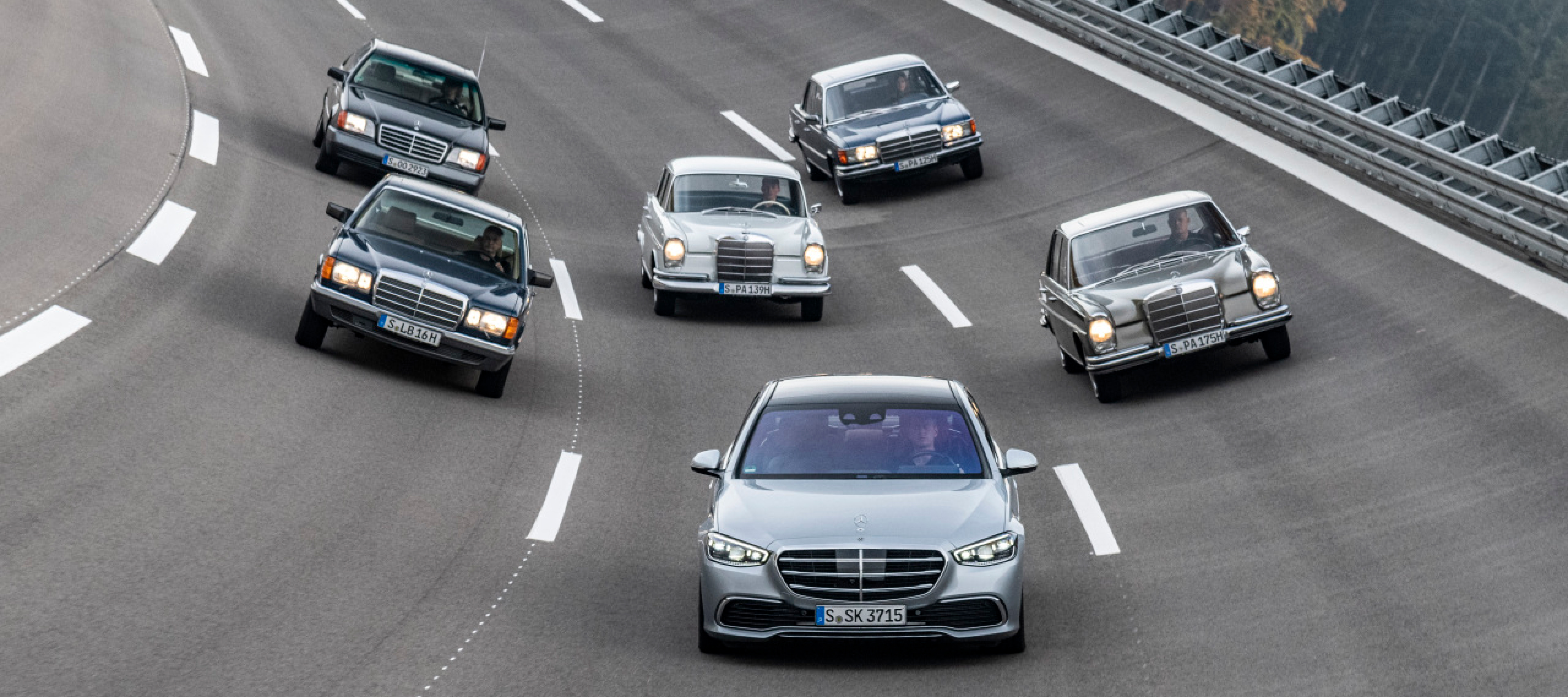
More than 50 years after its 1972 release, it’s clear that the arrival of the very first Mercedes-Benz S-Class was a landmark moment. Not just for Mercedes-Benz, but the global automotive industry. Arguably, the celebrated model with the W 116 designation has done more than any other to change the way the world looks at automotive luxury, safety, comfort, space and handling.


“No Mercedes was more important than the W 116 in establishing the brand,” says John Pearley Huffman, a senior editor with US-based Road and Track magazine.


What’s inarguable is that every vehicle on the road today owes something to the S-Class legacy. For starters, the W 116 pioneered the crash deformation structure, or crumple zones, which became an industry standard, helping to save countless lives in half a century since. It also shifted the fuel tank from the back of the car to above the rear axle and provided greater protection in the event of a collision.


Safety starts here


In 1978, Mercedes-Benz utilised the S-Class to debut anti-lock brakes (ABS), which for the first time allowed drivers to retain braking control in almost any condition, and is now a mandated fitment on every passenger and commercial vehicle.


Fittingly, the S-Class also gave the world another pioneering technology to improve car control, the Electronic Stability Program (known as ESP or ESC). Debuted in 1995, this offered immediate intervention and correction if a loss of driving control was detected. Now fitted to millions of cars around the world, this system helps to avert incidents that could cause serious injury.

“Every vehicle on the road today owes something to the S-Class legacy.”

In 1999, the W 220 model became the world’s first to offer radar-assisted active cruise control, known as DISTRONIC, and in 2005, this was advanced to DISTRONIC PLUS, a system that could autonomously bring the car to a complete halt, even from highway speeds.


This complemented the PRE-SAFE system introduced on the S-Class in 2002. It’s said that a Mercedes-Benz engineer observed the way a cat would prepare itself for landing while it was falling, and saw the potential for vehicles to anticipate a likely collision using sensors to trigger a series of preparations that would minimise any impact on passengers. The most recent S-Class introduced rear-facing airbags for the first time, to protect back-seat passengers in the event of a frontal collision.


Setting the agenda


As the brand’s flagship model, the S-Class has always set the agenda for standard inclusions. The features list of the very first S-Class might look unremarkable by today’s standards; but in 1972 it was almost unimaginable for a car to offer standard air-conditioning, power steering, an AM/FM stereo, power windows, central locking including the boot and fuel cap, and even a first aid kit. Leather upholstery was also available as standard or an option, depending on the model.


Other features to have been introduced across the years that enhance the luxurious feel of driving in an S-Class have included double-glazing windows for sound and temperature insulation, and soft-closing doors.


The S-Class wasn’t the first luxury saloon made by Mercedes-Benz – far from it. The origins of a breed of vehicle prioritising luxury, comfort and safety can be traced back to the early 20th century, and it was in 1949 that the Stuttgart manufacturer began using the designation ‘S’ to denote ‘Special’ for its Model 170 S.

A very special design


The lines might have been a bit squarer in the 1970s than today’s S-Class, the stance more upright, the imposing chrome grille a bit fancier. But you can certainly see the familial resemblance in the long, low stance and the classic three-box shape – albeit softened over time by gentler curves and flowing lines that not only please the eye, but also contribute to superior aerodynamics and optimised crash protection.


As stately as the original S-Class looks to today’s eye, the final design by Friedrich Geiger before his retirement as the company’s head designer was considered a stunning step forward from the W 108/109 model it replaced in the model range, which had been launched in 1965.


So much so that it became an immediate star, featured throughout the 1970s in US television shows such as Dallas, The Rockford Files, Charlie’s Angels and Starsky and Hutch, lending the brand an aspirational quality that has only grown across the decades since.

“…many of the ground-breaking innovations pioneered on the imposing S-Class would trickle down through the family models.”

The head of the family


The S-Class quickly became inestimably important to Mercedes-Benz as a halo car with its constant innovation and reputation for luxury and quality. But it also served as a template for the E-Class and C-Class models that followed, forming three pillars of the Mercedes-Benz passenger car range. The ‘children’ of the S-Class were beneficiaries of more than just design – many of the ground-breaking innovations pioneered on the imposing S-Class would trickle down through the family models, enriching the brand as a whole.


For Huffman, the W 116 was “the car that made Mercedes Mercedes”. It could equally be argued that every successive S-Class model since that ground-breaking release has become even more Mercedes, a trend which positions the model as the best-selling luxury saloon in the world as well as one of the most highly sought-after.


With each subsequent release – from the W 116 of 1972, through the succeeding 50 years – the S-Class has become ever more desirable. With an established reputation for packing in proprietary new technologies and systems, it continues to set the agenda for the entire industry to follow.

Learn more about Mercedes-Benz S-Class here.

By Steve Colquhoun

Discover more from the world of Mercedes-Benz.