Since the earliest days of Grand Prix racing, Mercedes-Benz has been at the forefront of motorsport innovation, continuously pushing the boundaries of design, engineering and performance. Nowhere has that quest been more evident than in the thrilling world of Formula 1.


Known as the Silver Arrows, Mercedes-Benz racing cars have demonstrated their speed, precision and technical prowess on the world's most challenging racetracks. Many of the technological advancements featured in these cars have found their way into our production vehicles, too. 


Beyond the race cars themselves, our legacy includes some of the greatest driving talents F1 has ever seen. Here, we reflect on the legendary drivers who have contributed to our success in F1.


Juan Manuel Fangio (1954-1955)


Juan Manuel Fangio, often referred to as ‘El Maestro’, is regarded as one of the greatest F1 drivers of all time. He competed in seven F1 seasons and won World Champion five times – twice with Mercedes-Benz.


Juan dominated the 1954 and 1955 seasons in a Mercedes-Benz W 196. The vehicle was remarkable for its time and was developed especially for very fast racetracks. Its revolutionary streamlined body reduced drag and increased the car’s top speed on the faster circuits.


The car’s advanced 2.5L and straight-eight engine was famed for its use of desmodromic valves – a system that provided more precise control over valve timing and allowed for higher engine speeds. The engine was also mounted at an angle, lowering the car's centre of gravity and improving handling.


Juan's mastery behind the wheel, combined with the technical superiority of the W 196, saw him win both the German and Swiss Grand Prix races in 1954. The following year, he secured his third World Championship, cementing his place as a motor-racing legend and establishing Mercedes-Benz as a force to be reckoned with in F1.


Stirling Moss (1955)


Sometimes referred to as “the greatest F1 driver never to win the World Championship”, British driver Sir Stirling Moss was nevertheless famed for his skill and bravery. 


One of Stirling’s most famous victories came at the 1955 British Grand Prix. Driving the W 196 alongside team-mate Juan Manuel Fangio, the pair engaged in a thrilling duel – before the British driver’s raw speed and tactical brilliance saw him become the first Englishman to win his home Grand Prix.


In the same year, Stirling achieved what many consider to be his greatest triumph: winning the Mille Miglia. Partnered with co-driver and navigator Denis Jenkinson, Stirling piloted a Mercedes-Benz 300 SLR to victory in the gruelling 1000-mile race across Italy. Their time of 10 hours, seven minutes and 48 seconds set a record that was never broken.


Michael Schumacher (2010-2012)


F1 legend Michael Schumacher chose to return to the track with Mercedes-Benz in 2010 for a new chapter in his career. He joined the newly formed factory racing team Mercedes-AMG PETRONAS F1 as Nico Rosberg's team-mate.  Bringing the experience of seven World Championships and 91 race wins, Michael’s unparalleled experience suited the Mercedes-Benz F1 team as it entered a new era. 


Michael brought his vast experience to the Mercedes-Benz F1 team, and, during his three-year stint, helped establish a foundation for its future dominance. 


Team principal Toto Wolff later reflected on Michael's time with Mercedes-Benz, saying: “Michael is one of the founding fathers of Mercedes' recent success in F1. He has helped establish these structures from 2010 to 2012.”


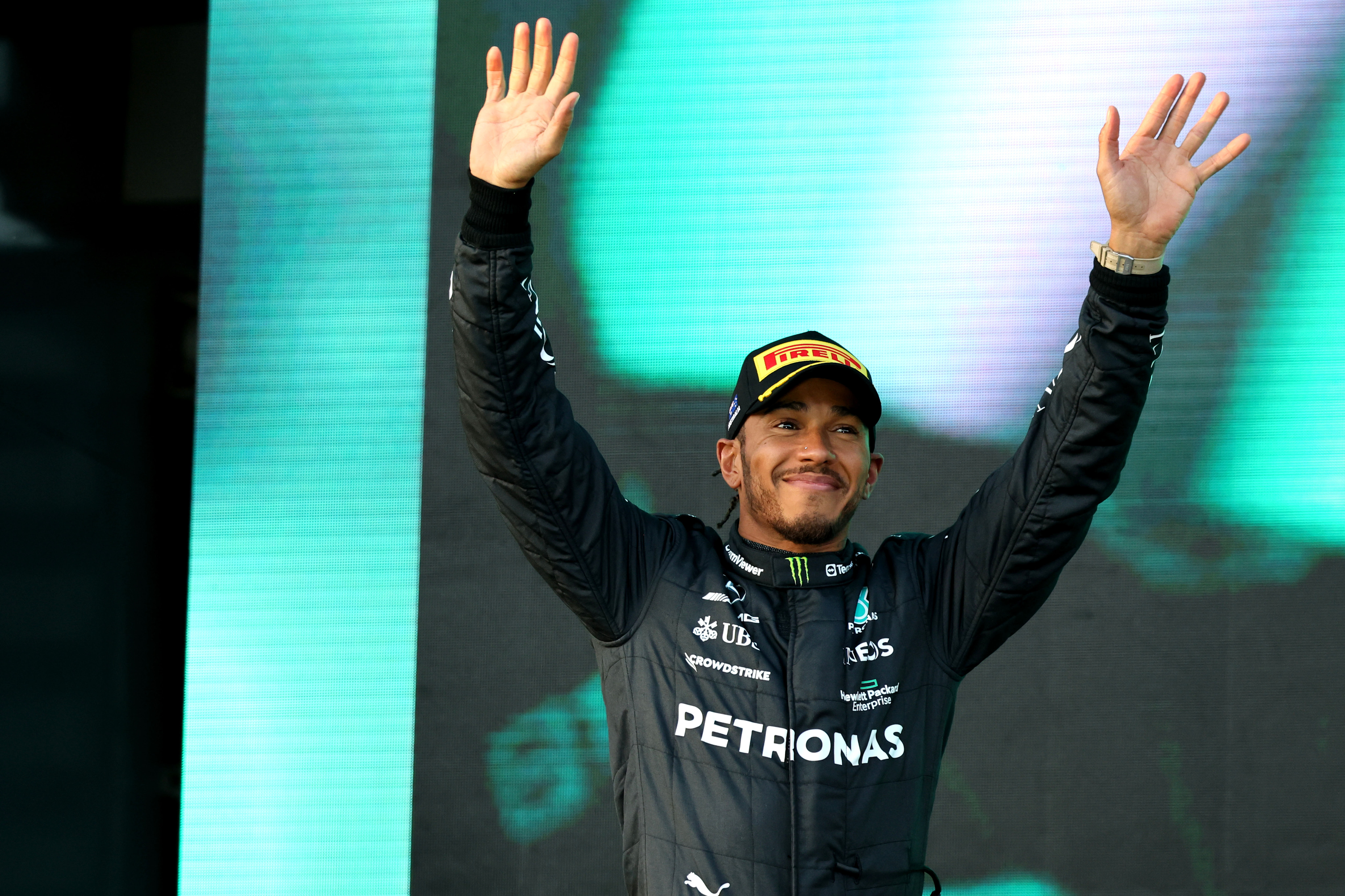
Lewis Hamilton (2013-2024)


Lewis Hamilton succeeded Michael at Mercedes-Benz in 2013. Though he had already won a World Championship in 2008 at the age of 23, few could have imagined the extraordinary feats that would follow, elevating him to one of the greatest drivers in F1 history.


Among a phenomenal list of highlights from Lewis' journey with Mercedes-Benz:


2013 – in his debut season with the team, Lewis secured several poles and podiums, plus a race win.


2014 – Mercedes-Benz won 16 of the 19 races, with Lewis securing his second World Championship and becoming the most successful British Formula One driver.


2015 – after winning his third World Championship and a historic forty-third career victory at the US Grand Prix, Lewis joined the likes of Michael Schumacher as one of the greatest F1 drivers of all time. 


2017 – behind the wheel of the W 08, Lewis won his fourth Drivers' Championship at the Mexican Grand Prix.


2018 – at the age of 33, Lewis clinched his fifth World Championship, equalling the record established by Juan Manuel Fangio.


2020 – in a record-setting season, Lewis won his seventh World Championship in the W 11. He achieved 11 wins, 10 poles, and 14 podiums, making him statistically the most successful F1 driver ever.


Lewis’ partnership with Mercedes-Benz set new standards of performance in F1. The unique chemistry between the Brit’s supreme driving skills and the brand’s engineering prowess established a period of almost unequalled dominance. 


The stories of Juan, Stirling, Michael and Lewis are not only feats of individual brilliance – they are also part of a larger narrative about the enduring legacy of Mercedes-Benz in F1. In their own way, each of these champions has contributed to the brand's success in motorsport. 


As F1 continues to evolve, with new technical regulations and challenges on the horizon, the legacy built by champions like these serves as both a source of pride and a foundation for future success.

Discover more from the world of Mercedes-Benz.